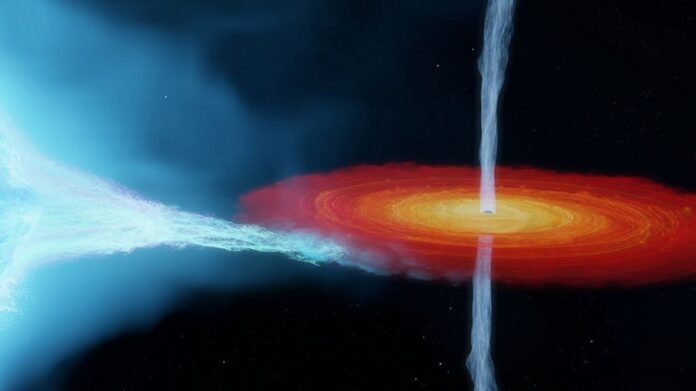
A new examination has revealed new details about the first detected black hole, which was discovered in 1964 and became the subject of a friendly bet among renowned scientists, including that it is larger than previously known. Researchers have assured this Thursday that new observations of the black hole Cygnus X-1, which orbits in a stellar junction with a large and luminous star, showed that it has 21 times the mass of our sun approximately 50% more than what previously believed. While it remains one of the closest known black holes, they found that it is somewhat further away than previously calculated, at 7,200 light-years the distance light travels in a year, 5.9 trillion miles (9.5 trillion kilometers) away. the earth.
Black holes are extremely dense with gravitational forces so fierce that not even light escapes. Some, the supermassive black holes, are immense, like the one at the center of our galaxy the Milky Way, 4 million times the mass of the sun. The smallest stellar-mass black holes have the mass of a single star. Cygnus X-1 is the largest known stellar-mass black hole in the Milky Way and one of the strongest X-ray sources seen from Earth said astronomer James Miller-Jones of Curtin University and the International Research Center. Radio Astronomy in Australia, who led the study published in the journal Science.
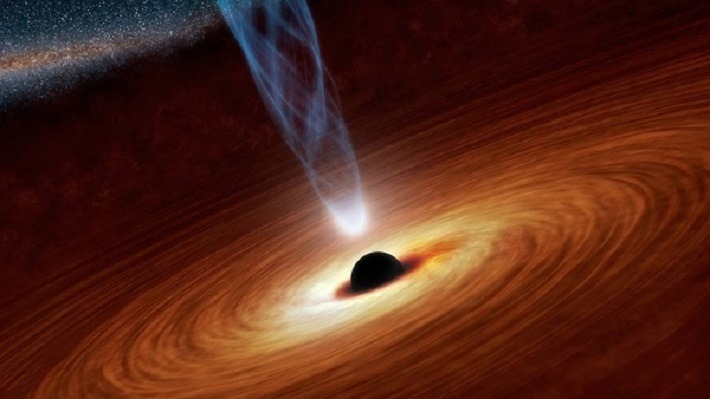 This black hole spins so rapidly, almost at the speed of light, that it is approaching the maximum speed predicted in physicist Albert Einstein’s theory of general relativity added Miller-Jones. It devours the material that is detached from the surface of the star next to which it orbits a blue supergiant about 40 times the mass of our sun. It began its existence between four and five million years ago as a star up to 75 times the mass of the sun and collapsed into a black hole a few tens of thousands of years ago.
The research included data from the Very Long Baseline Array radio telescope comprising 10 US observing stations. After Cygnus X-1 was first listed as a black hole a bet was made among physicists. Some like Stephen Hawking, who bet against it being one and others like Kip Thorne, who did believe it was. Hawking eventually agreed, owing Thorne a subscription to Penthouse magazine. In fact, I had no bets based on these findings Miller-Jones said.