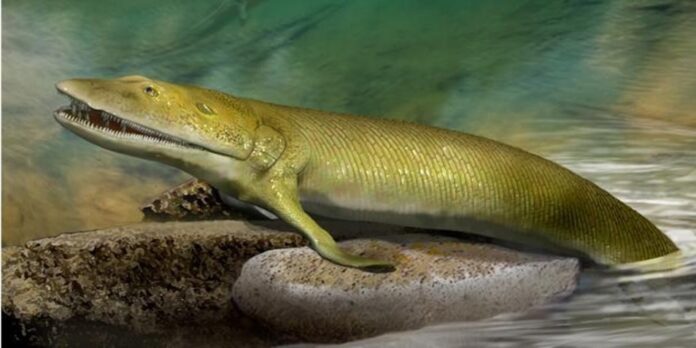
Scientists at Harvard University have designed zebrafish that show the initial formation of limb-shaped appendages after the change of a single gene. According to the authors of the study, published in the journal Cell, the mutation marks a fundamental step in our understanding of the evolution from fins to limbs similar to ours and shows how surprisingly simple genetic changes can create great advances in the development of complex structures. Similarly, the results may shed light on the sea-to-land transition of vertebrates.
It was amazing that a single mutation could create completely new bones and joints,” says M. Brent Hawkins, first author of the study. “In the 30,000 species of teleost fish, none have this type of variation, so the fact that we found a mutant like this took our breath away,” he acknowledges. Teleosts form a diverse lineage that includes goldfish, salmon, eels, flounder, clownfish, pufferfish, catfish, and zebrafish. There are more species of teleosts than all of the birds, mammals, reptiles, and amphibians. However, despite a large number of species and a wide range of shapes, sizes, and habitats, the pectoral fin of teleosts is surprisingly simple and unchanged.
The mutation that Hawkins and his colleagues discovered causes a change in the bones of the zebrafish’s pectoral fin called ‘proximal radials’, which adhere to the fish’s shoulder joint, similar to how the human arm attaches to our own. shoulder. But unlike humans and other tetrapods, the zebrafish does not have a number of these skeletal elements that articulate in the joints, like the components of our arm and fingers. With this mutation, a new set of long bones called develops that can articulate with the existing proximal radials, forming a joint similar to our elbow.
In this single mutation, you get the new bone, you make the joint, and you make the muscle attachments in one go,” says lead author Matthew Harris associate professor of Genetics at Harvard School of Medicine and Orthopedics. It was not necessary to have a mutation in the gene for muscle, in the gene for joint and the gene for bones; the system is coordinated in such a way that whatever our change, it can unite all these things in unison, “he says.
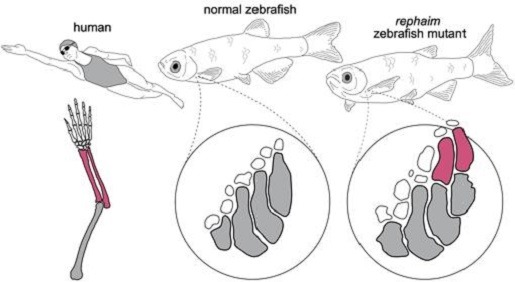
Genetic analysis revealed that mutations in either of the two genes, vav2 and wasabi, can independently cause this developmental change. Neither gene has previously been linked to skeletal development, but analysis revealed that both activate Hox programs that shape the mid-limb region. “With these zebrafish, we were able to show that these mutations activate programs that are fundamentally believed to only be found in one limb,” says Harris. “So not only do we have the phenotype of something never before seen in teleost fish, but we show that we can activate ancestral patterns that were thought to be associated only with the limbs,” he adds.
The limbs are believed to be a key evolutionary innovation, allowing vertebrates to walk on land and, in the case of birds and bats, to fly. What these results show is that a group of fish thought to have lost or silenced the machinery necessary to develop limb-shaped appendages retain an innate latency to form these structures. “With our work, we’ve found unexpected similarities between fins and limbs, and I think there are even more similarities that have yet to be discovered,” says Hawkins.
Despite these findings, the question remains whether these new bones change the functionality of the zebrafish’s pectoral fins. The next steps will incorporate fine-scale video microscopy to determine if the articulation of these new bones is sufficient to influence how the fish move. “Normally, the structures are not present to allow the articulation necessary for movement on the ground,” says Harris. “It would be very interesting to see, for example, what happens if we put our mutant on a platform.”
With the discovery of these mutants, the researchers open a new line of questions about how vertebrates took their first steps towards movement on land and about the genetic and developmental mechanics necessary to make this happen. “Although it is not the whole story, what we are seeing is a window into the puzzle of how to go from a fin to a modern limb,” says the researcher. And for me, I keep what these mutants can tell us about development and the ability to form complex structures. It’s a great reminder that not all monsters are scary. If you look closely, they can sometimes tell you a lot about yourself, ”he reflects.