Imagine this scenario: It is 2:00 AM. You are sitting at your desk, or perhaps lying awake in bed, and a sequence of words hits you. It is a verse, a chorus, a raw expression of exactly how you feel in that moment. You write it down furiously. It is perfect. It captures heartbreak, the joy, or the nostalgia perfectly.
But then, the silence returns. You stare at the paper, and the words just sit there. They are flat. You can hear a faint melody in your head, but you don’t know how to play the piano. You don’t have a band on speed dial. You certainly don’t have thousands of dollars to book a recording studio. So, like countless other creative sparks before it, that song dies on the page.
This is the “Great Filter” of musical creativity. For decades, the ability to turn poetry into song was reserved for the privileged few who had years of music theory training or deep pockets.
But what if the barrier between your words and a fully produced song wasn’t a wall, but a door? And what if you already held the key?
Welcome to the era of AI Song Maker. We are witnessing a paradigm shift where your lyrics are no longer just text—they are the blueprint for professional-grade audio, generated in minutes.
The Silent Struggle of the Modern Storyteller
Before we dive into the solution, we need to acknowledge why traditional music production has been such a dream-killer for so many aspiring artists.
The traditional path to creating a song is an endurance test. It involves a complex chain of dependencies:
- Composition: You need to understand chord progressions and melody structures.
- Arrangement: You need to know which instruments fit the mood.
- Production: You need to record, mix, and master the audio so it doesn’t sound like it was recorded in a tin can.
I remember trying to produce a simple track for a video project last year. I spent three days just looking for a freelance musician, another week waiting for the demo, and hundreds of dollars for a result that wasn’t quite what I envisioned. It was exhausting. The friction was so high that I almost gave up on the idea entirely.
This is where the “AI Lyrics to Music” technology changes the game. It doesn’t just speed up the process; it democratizes the art form.
My First Encounter with AI Song: A Personal Experiment
I was skeptical at first. The idea that a machine could understand the emotional nuance of human language seemed far-fetched. To test this, I took a stanza from an old poem I wrote about a rainy autumn day—something melancholic and slow.
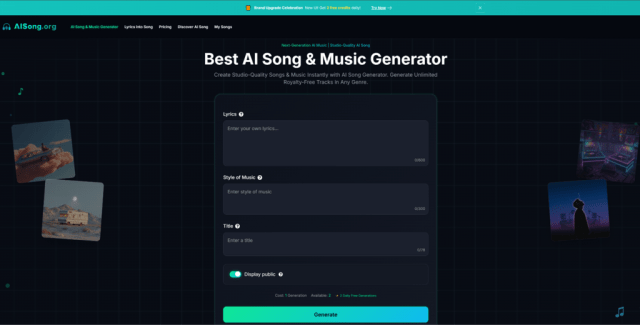
I navigated to the platform, pasted my text, and selected a “Lo-Fi Jazz” style. I didn’t have to mess with sliders or frequency knobs. I just told the AI what the vibe was.
Three minutes later, I pressed play.
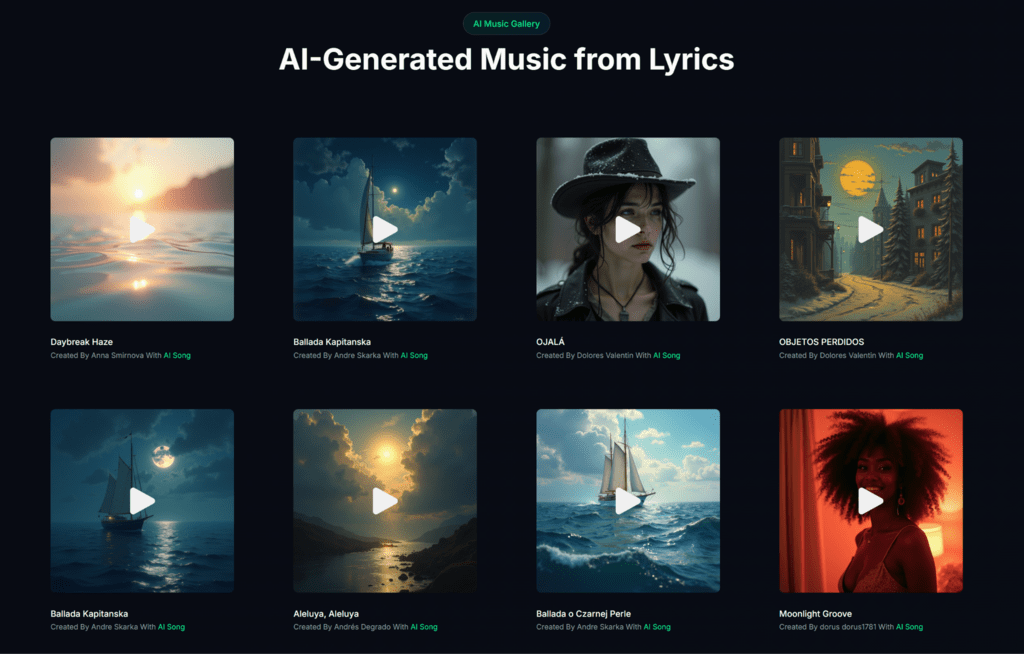
I didn’t just hear a robotic voice reading text over a beat. I heard a soulful, slightly raspy vocal delivery that matched the rhythm of my syllables. The piano chords in the background were minor and moody, perfectly underscoring the word “rain.” It wasn’t just a song; it was my song. The AI hadn’t just read the lyrics; it had interpreted them.
This is the core promise of AI Song. It acts as your virtual session musician, producer, and mixing engineer, all rolled into one intuitive interface.
How It Works: From Text to Track in Three Steps
The beauty of this platform lies in its sophisticated simplicity. You do not need to know what a “compressor” or a “reverb tail” is. You only need to know what you want to say.
1. The Lyrical Input
It starts with your words. You can input a full song structure—Verse, Chorus, Bridge—or just a few lines of inspiration. The Natural Language Processing (NLP) engine analyzes the sentiment of your text. Is it angry? Is it celebratory? Is it a quiet confession? This analysis dictates the energy of the composition.
2. The Stylistic Direction
This is where you become the director. You choose from over 50 distinct genres.
- Want an energetic anthem? Choose EDM or Rock.
- Need something for a romantic video? Select Acoustic Ballad or R&B.
- Looking for something experimental? Try Synthwave or Classical.
3. The Generation and Ownership
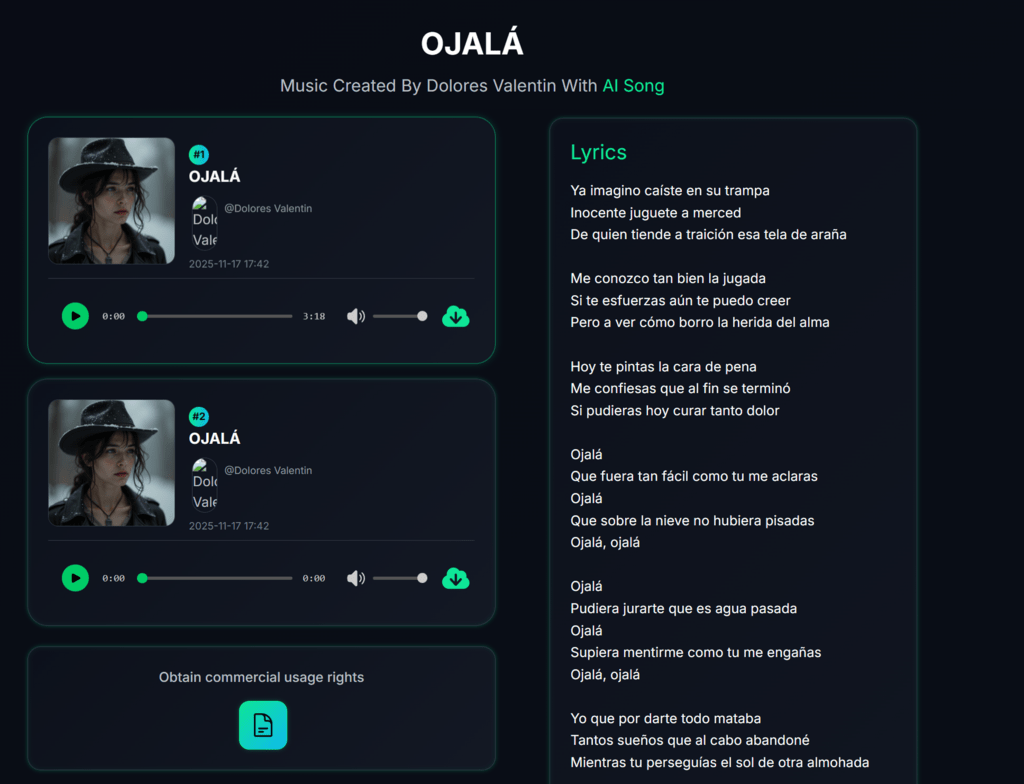
Once you hit generate, the algorithms weave your lyrics into a unique melody and backing track. Within moments, you can download a high-fidelity audio file.
Here is the most critical part: You own it. Unlike many other tools that trap your creations in licensing hell, AI Song ensures you have the commercial rights. You can put it on Spotify, use it in a monetized YouTube video, or feature it in an advertisement.
The Great Divide: Traditional Production vs. AI Song
To truly understand the value proposition here, we need to look at the numbers. The difference between the old way and the AI way is not just about time; it is about accessibility.
Here is a breakdown of how the two approaches compare:
| Feature | AI Song (AI Lyrics to Music) | Traditional Music Production |
| Time to Completion | Under 5 Minutes | Weeks to Months |
| Cost Barrier | Free (With Daily Credits) | High (Studio time, musicians, gear) |
| Skill Requirement | None (Just your lyrics) | Advanced Music Theory & Engineering |
| Emotional Matching | Automated NLP Sentiment Analysis | Depends on the musician’s interpretation |
| Commercial Rights | Full Ownership Included | Complex contracts and royalties |
| Genre Flexibility | 50+ Genres instantly available | Limited by the musician’s specialty |
As you can see, the friction is virtually eliminated. You are no longer paying for time; you are investing in pure creativity.
Fueling the Creative Engine: The Daily Rewards System
One of the most frustrating aspects of premium software is the “paywall anxiety”—the fear of using up your credits on a bad idea.
AI Song addresses this with a feature that I genuinely appreciate: The Daily Rewards System.
The platform operates on a philosophy that creativity should be a daily habit, not a luxury.
- Login Bonus: Simply by logging into the platform, you receive 2 free credits every single day.
- Risk-Free Experimentation: These credits allow you to test different genres or rewrite lyrics without worrying about wasting money.
This system changes your psychology. Instead of hoarding credits for “the perfect song,” you are encouraged to play, experiment, and iterate. It turns music creation into a daily ritual rather than a rare event.
Who Is This For?
While professional musicians use this for rapid prototyping, the true power lies in how it serves non-musicians.
- Content Creators: If you are a YouTuber or TikToker, you know the pain of copyright strikes. Creating your own background music solves this instantly.
- Writers and Poets: Finally, you can hear your words as they were meant to be heard—rhythmically and melodically.
- Educators: Create custom songs to help students memorize complex topics.
- Marketers: Produce unique jingles for campaigns without hiring an agency.
The Future of Sound is Collaborative
We are standing at the edge of a new frontier. Some purists argue that AI removes the “soul” from music. I argue the opposite. By removing the technical barriers, we are allowing more soul to enter the world. How many brilliant songs were never heard because the writer couldn’t play guitar? How many emotions were never shared because the production cost was too high?
AI Song is not replacing the artist; it is amplifying the artist. It is the ultimate collaborator, one that never gets tired, never runs out of ideas, and is always ready to jam.
Start Your Musical Journey
The distance between your notebook and the speakers has never been shorter. You have the words. You have emotions. Now, you have the instrument.